Grok 4.7 on the quick suite
xAI released Grok 4.7 on 21 September. I ran it in Cursor CLI on 24 October, beside Claude Opus 5.5 and GPT-6.1 Sol.
Speed#
Time to finish
Seconds from starting the tool to its exit, one short explain task. Lower is better.
Every run, one row each
| Model | Tool | Run 1 | Run 2 | Run 3 | Run 4 | Run 5 | Run 6 |
|---|---|---|---|---|---|---|---|
| GPT-6.1 Sol | Codex CLI | 10.1 s | 9.2 s | 12.8 s | 9.0 s | 10.2 s | 8.7 s |
| Grok 4.7 | Cursor CLI | 28.8 s | 13.3 s | 12.4 s | 13.0 s | 12.7 s | 12.7 s |
| Claude Opus 5.5 | Claude Code | 16.0 s | 12.1 s | 19.4 s | 16.3 s | 14.1 s | 20.4 s |
The table scrolls sideways on a small screen.
Source: WorkloadBench at workloadbench.brenhq.com, updated 24 October 2026. 18 runs, six per model, medium effort, each in its own tool.
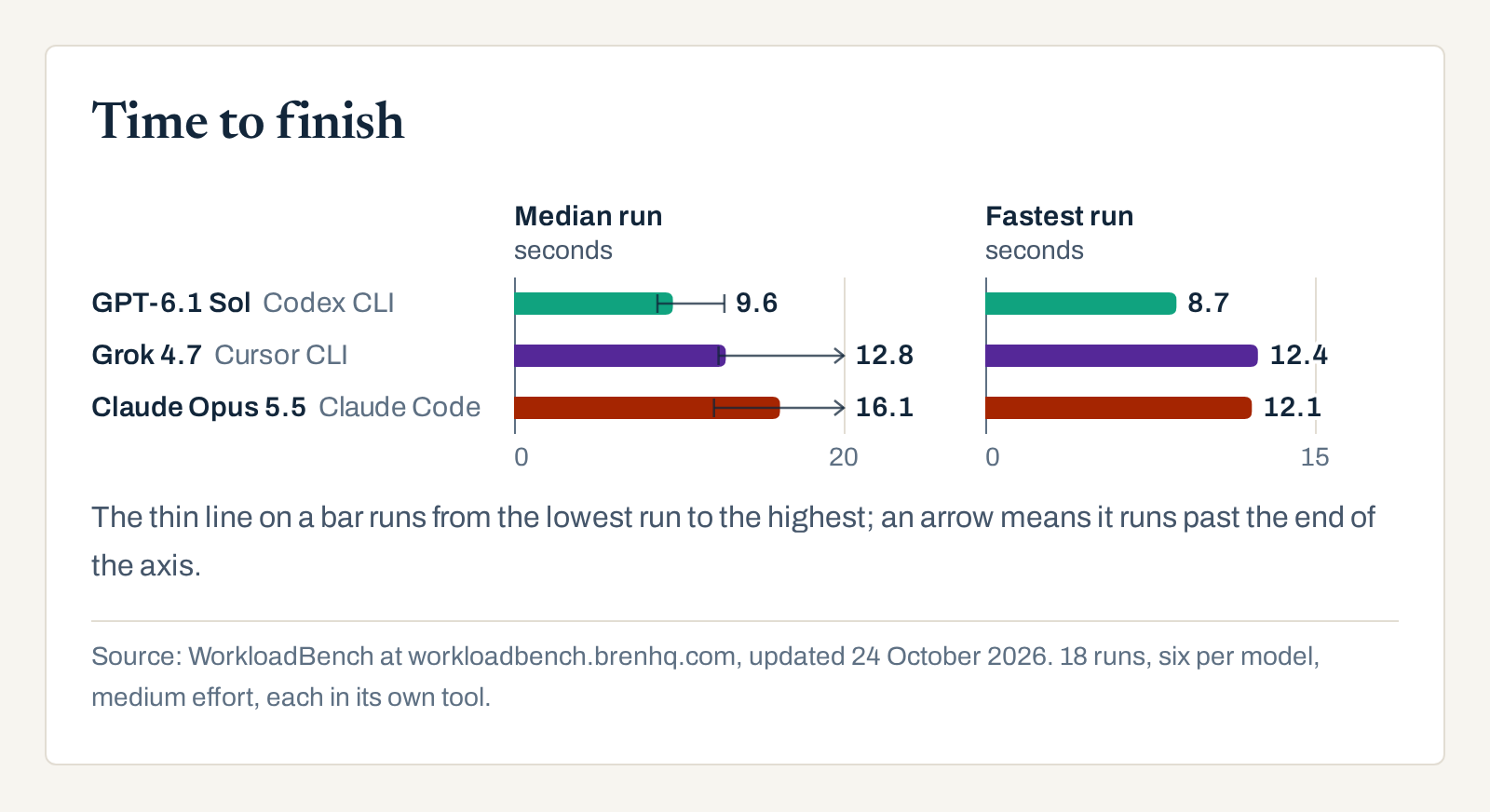
- Grok 4.7: 12.4 to 28.8 s
- Claude Opus 5.5: 12.1 to 20.4 s
- GPT-6.1 Sol: 8.7 to 12.8 s
Cost#
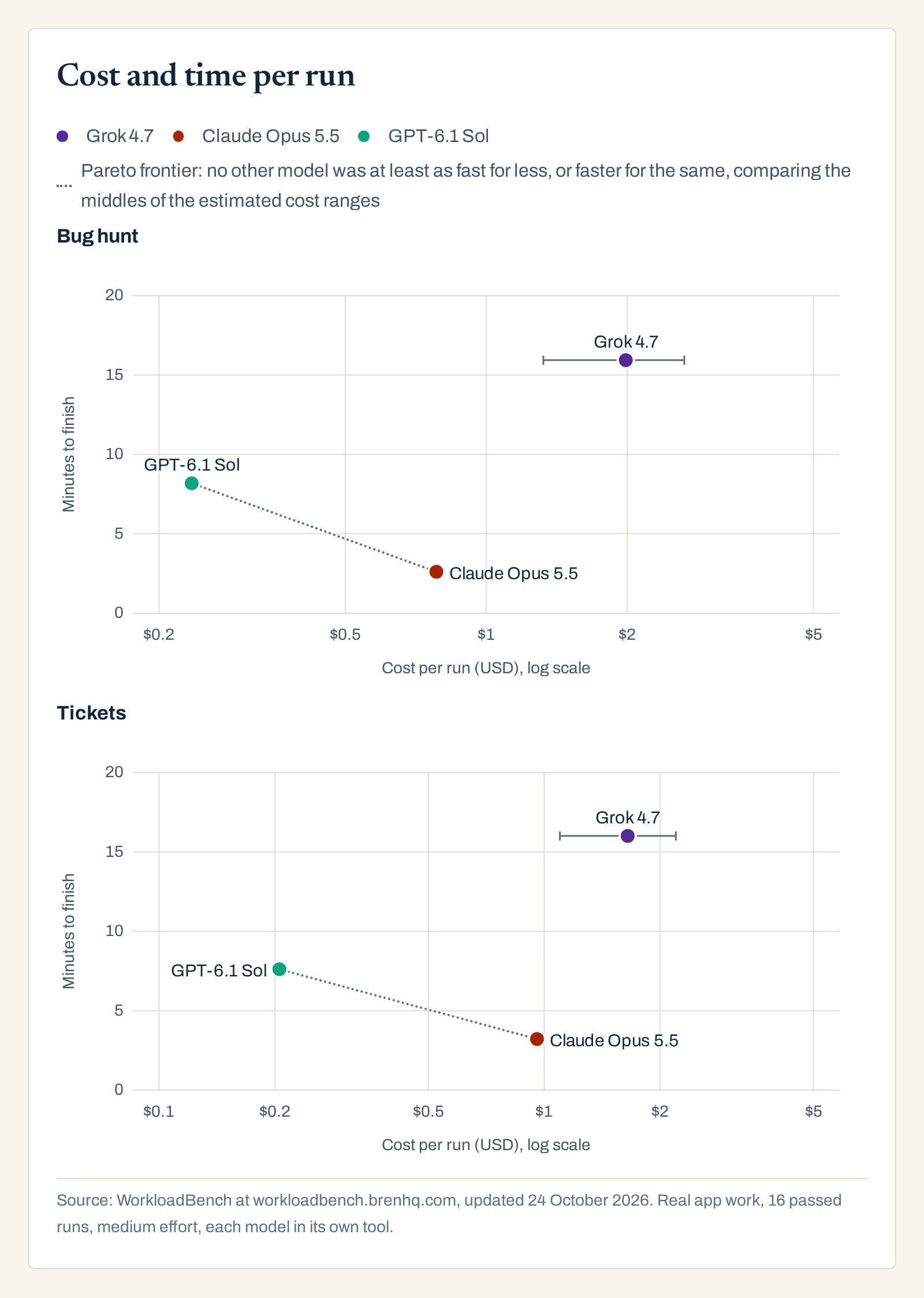
Cost and time per run
Real app work, median passed run at list prices. Every bug-hunt run fixed all 20 bugs, and every tickets run passed all 17 ticket tests. Two Grok 4.7 tickets runs failed the gate, so their cost is left out. Lower left is cheaper and faster.
- Grok 4.7
- Claude Opus 5.5
- GPT-6.1 Sol
- Pareto frontier: no other model was at least as fast for less, or faster for the same, comparing the middles of the estimated cost ranges
Bug hunt
Tickets
A run passes its gate when every test passes, its own new ones included, and no existing test file was changed, renamed or deleted; new test files are fine.
Source: WorkloadBench at workloadbench.brenhq.com, updated 24 October 2026. Real app work, 16 passed runs, medium effort, each model in its own tool.
Notes
Grok 4.7's costs are a range: a request whose prompt reaches 200k tokens costs twice as much for all its tokens, its real-work runs read 200k prompt tokens or more in all, and Cursor reports only each run's totals. GPT-6.1 Sol's are a range because Codex logs 0 cache writes on every run.
Every check#
The same checks for all three.
Hidden tests are tests the model never sees.
| Check | Grok 4.7 | Claude Opus 5.5 | GPT-6.1 Sol |
|---|---|---|---|
| Four small coding tasks, every setup: runs that passed | 60 of 60 | 60 of 60 | 60 of 60 |
| ASD-STE100 instruction on the explain task: runs that passed | 3 of 3 | 3 of 3 | 3 of 3 |
| Bug hunt: bugs fixed of 20, each run | 20, 20, 20 of 20 | 20, 20, 20 of 20 | 20, 20, 20 of 20 |
| Bug hunt: runs that failed the gate | 0 of 3 | 0 of 3 | 0 of 3 |
| Bug hunt: estimated cost per run at list prices, median | $1.324 to $2.648 | $0.783 | $0.223 to $0.247 |
| Tickets: hidden tests passed, each run | 17, 17, 17 of 17 | 17, 17, 17 of 17 | 17, 17, 17 of 17 |
| Tickets: runs that failed the gate | 2 of 3 | 0 of 3 | 0 of 3 |
| Tickets: estimated cost per run at list prices, median | $1.098 to $2.196, 1 of 3 runs passed | $0.958 | $0.195 to $0.215 |
The table scrolls sideways on a small screen.
Pass counts and scores count every run; costs use passed runs only. Two Grok 4.7 tickets runs failed the gate: one changed an existing test file and one changed two existing test files. Runs from Grok 4.7 24 October, Claude Opus 5.5 22 September to 2 October and GPT-6.1 Sol 29 September to 2 October, 2026.
How I ran it#
Background and method
Grok 4.7 ran in Cursor CLI 2026.10.01-e373342 as Cursor's medium version, Claude Opus 5.5 in Claude Code 2.1.280 or 2.1.284, and GPT-6.1 Sol in Codex CLI 0.159.0, all at medium effort. All three ran in Docker on my subscriptions, with no API keys. In its fresh login, Cursor CLI loaded three of Cursor's public plugins (Linear, Deploy on AWS and shadcn), and in the real-work runs it started shadcn's MCP server.
Time to finish is the whole run on one short explain task, from starting the tool to its exit, so it includes start-up. A run passes when the answer names the month logic and the ValueError. The three took turns.
The checks are four small coding tasks with no skill, a placebo file and three token-saving skills, three runs each; the ASD-STE100 instruction on the explain task; and a bug hunt with 20 planted bugs and three sprint tickets in a small TypeScript app, graded by hidden tests. Opus 5.5 and Sol use their published runs of the same tasks.
Costs are list-price estimates from each passed run's tokens. Grok 4.7 is $2 per million input tokens, $0.50 cached and $6 output, and xAI lists no cache-write price. A request whose prompt reaches 200k tokens costs twice as much for all its tokens, and Cursor reports only each run's totals. 63 of its 69 runs read fewer than 200k prompt tokens in all, so no request in them reached the higher rate. Its six real-work runs read 200k or more, so each one's cost is a range, from every token at the lower rates to every token at the higher ones. Opus 5.5's cost includes cache writes at twice its input price, and Sol's is a range because Codex logs 0 cache writes on every run. Grok 4.7 drew on my Cursor plan's usage, and Opus 5.5 and Sol on my subscriptions.
The run records are in results.json, under launch31_timing, launch31_runs and launch31_real_runs, and Opus 5.5's and GPT-6.1 Sol's under runs, ste_runs and bughunt_runs.